XXXIII/A
I am puzzled by this Gospel passage. I have always found it difficult but this week its radical message seems to have become stronger. My attention is taken by the dialogue between the third servant and the master. What went wrong?
From this parable, two opposing views of life come forth: how do I see life, do i see it as an opportunity to be fruitful, to use what the Master has given me in order to give meaning and direction to my life? or do I consider my whole existence as a long trial, something to be lived in fear of failure and rejection?
And who is the master? If he stands for God in the parable, what do I think of Him? Is He the one who is after my well-being or someone harsh and demanding who only wants to use me for His advantage?
These questions, I think, are at the core of this passage. If I answer, I may get the key to understand and live out this page.
I don't buy the third slave response: if he knew that the Master is someone who is powerful enough to turn every opportunity to His own advantage, then his behavior and excuse just doesn't make sense: he believes so deeply that he's doing the right thing that he can't understand it doesn't make sense - he's justifying his sloth on the account of the power of the master: "I didn't do anything because I was afraid of you." Doesn't make sense and yet often it's what I do with God, too. It's very easy to fall into this trap - justify my behavior and blame God. But the Gospel always unveil my stupidity and forces me to be truthful. (I even wonder if this servant actually spent any time thinking about what excuse to give to the Master, or he just said the first thing that came to his mind.) He is paralyzed by his worldview: the Master is powerful, I can fail... why try? Lots of people live their lives using the same worldview.
The other servants seem to have a different attitude. I like the "Immediately" that Matthew puts int he text. There seems to be some kind of energy in what they do. Not only they invest the money but they are totally involved in the work. I can understand why they are so excited about their profit. They live their lives "out there,"taking risks with the gifts they have received. They trust the Master and they know that they are trusted by Him. What difference does this make in my life: I know that I trust God, but am I trustworthy, can He trust me? And, does the fact that He trusts me make any difference in my life? Do I live i fear of failure or do I feel empowered to use my gifts?
These guys don't seem to be concerned about the Master's powerful attitude. What can I conclude? Is the Master really harsh? or was only the way the third slave saw Him? (I noticed that the image of the master has not been discussed in the text: the Master doesn't refute the lazy servant's view of Him. What to make of this?). Obviously they feel different about Him. I know that our image of God shapes our behavior. I need to explore what do I think of God.
I do tend to be closer to the two servants: they seem to have acted moved by a positive worldview. Their mater knows them personally: each of them had a particular gift for administration; the master has been respectful of this and has given to them according to what they could handle. Also, when He comes back He just doesn't take the money and gets rid of the servants: He blesses them with more. Even more surprisingly, the Master praises them publicly (pretty unheard of!). He gives them more and more importantly, allows them to share in the master's "joy." This doesn't seem the behavior of a harsh and demanding Master. He behaves quite differently than I would expect. The servants relate to the Master in an open way and this openness allows them to experience an inner transformation (which has obvious physical consequences - Joy).
There is no tyranny or capitalism, there is no blaming the Master about being after profit. Sorry, third servant, but I still don't see your point of view: you wanted to cover-up your own issues and lack of interest. Didn't work because it never does. In the end, accountability is a very personal issue and we can't blame anybody for your failures. The Master saw through it - if you were really that scared, you could at the least put the money in the banks: that's quite risk-free, and takes little effort on your part. You didn't even do that. Don't buy it. I bet the Master would have been more merciful if you had lost your money in an investment - at the least you tried. But nothing begets nothing.
That's why Jesus closes the parable with those hard words: "for to everyone who has, more will be given and he will grow rich; but from the one who has not, even what he has will be taken away." We always bring to God more and more request to get more and more "blessings" (=stuff). Why would He give us more if we don't take car of what we already have? How can we ask for blessings when we are not willing to get rid of sin? Can blessing and sin co-habitate?
The key to understand this passage is to see how the servants behaved: they were given a task, which was based on trust and personal love, and they were asked to be faithful to it.
Sunday, November 13, 2011

Monday, November 7, 2011
Called again to Communion

I am at a workshop for new pastors. I have been trying to prepare myself for this week by putting in order my thoughts and my notes on the identity and role of the pastor. Not knowing what the workshop was really about, I tried to create some kind of background. Last night I was reading some of my notes and I read something that struck me. It's about Communio, the unifying bond that exists among all the baptized. "It is all en-compassing for it embraces every member of the Church."
It sounded so beautiful. I feel a particular calling to create and live Communio and probably that's why I felt it so close to me. I pictured it in my mind, like a mantle that covers every single person bestowing both dignity and equality to all.
I went downstairs for Night Prayer. I went earlier so that I could some time to meditation. I found my seat and I looked up: the icon of the Trinity. I kept looking and looking and suddenly the idea of Communion and the Trinity became one. The Trinity is the source and model of Communion. Everything flows from there and goes back to there.
I wonder: is the reason we experience so much lack of Communion in our world, in your families and in our Church to be found in the lack of understanding of the Trinity? Is it possible that we have forgotten what we are supposed to live - the life of the Trinity in us and in our midst?
A strong desire: I need to deepen myself in the mystery of Baptism, the Sacrament that allows me to be immersed in the Trinity and that allows me to live the life of the Trinity. How can I be successful in my ministry as pastor if I don't help people to live out their own Baptism? This should most certainly be a priority of mine. I know that life has a way of moving priorities around and that the "everyday grind" finds always a way to demand our attention, but our Baptism must shape all we do, at all times.
As JP2 said, the Church must be "home and school of Communion,"the Trinity is the protagonist, and our Baptism the way to realize and live out this Communion.
How can I do that? What can I do to understand and help people understand this great gift?
Sunday, November 6, 2011
Live in the light or darkness?
 XXXII/A Ordinary Time
(Wisdom 6:12-16/Psalm 63:2, 3-4, 5-6, 7-8/1 Thessalonians 4:13-18/Matthew 25:1-13)
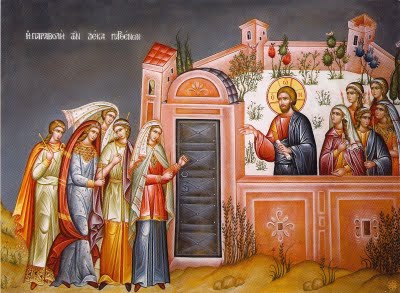
We are moving towards the end of the liturgical year and it's only normal that we face the topic of the end of the world and the coming of "Jesus to judge the living and the dead." Contrasting images make this reality more vivid: wedding celebration and a door shut, brightly burning torches and dim lamps. Lifelike, these images reveal to me not only an eternal condition but also a choice I am given: the light does not go out suddenly but as a result of a choice the foolish maiden made. Then, from the start I have to ask myself which group do I want to join, how am I going to live me life? In darkness, with a half-lit lamp or in the brightness of full torch? The dominant image of the Kingdom is found in the maidens. The kingdom is like them....
"Here's the Bridegroom!" I like to think of this image. My life is a response to this cry, the bridegroom, whom I have been waiting, is coming. This is a powerful image for me: life as "going out, moving to encounter Someone who comes for me." Whose voice is it?
I am surprised, though; I do not associate wedding celebrations with sleeping (what a party!). Yet, the delay of the bridegroom causes everybody to fall asleep. In life I experience the same: sometime the routine or the occupations of life make me "drowsy," dull to the primary duty I have - to keep that lamp burning. I, too, fall asleep. As the song of songs says: "I sleep, but my heart keeps vigil." The problem is not in falling asleep but ignoring my duty completely. The foolish and the wise have been asked to do the same thing and given the same opportunity: why the difference?
Wisdom is a great gift that God has given us. It allows us to see the world and think in a different, practical way. The maidens were wise because they remained focused on the task; the others were foolish because they assumed the Bridegroom would behave according to their expectations. They didn't consider that he could be late. How wrong they were! how many times I also have some expectations of God: I want Him to behave in a certain way at a certain time. The problem is not here, I think; the problem is that I consider my way as the only way and therefore I get caught unprepared. Although I can still let Him know what I think, I must always keep my attention on what He is about to do. After all, it's His party! It's His Wedding. I am only one of the invited.
A Cry comes in the middle of the night, waking everybody up. Whose voice is it? Why don't we know? Is it the Bride? I wouldn't be surprised. Like the Bride in the Song of Songs, her heart would be vigilant, her eyes sharp to distinguish in the darkness of the night the shape of her Beloved.
In the reality of His arrival, everything makes sense: our actions are revealed for what they are. Foolish or wise we will all react to His presence. Now the party can really start!!!!
This parable is about relating to the arrival of the Bridegroom and the fulfillment of the task given. That's why the wise maidens do not respond as I think they ought to. They do not want to share what they have. Isn't that... unchristian? In this case, they are doing the right thing. There are times in our lives when we cannot let anyone else do something for us, or we cannot share in the work of another. Our response to the task has to be fully personal. Nobody goes to heaven (to the party) by proxy. Nobody can be loving in my stead, or be good instead of me, or be honest. These are all things that I have to do on my own, for myself. The invitation I received to participate to the party was not shareable. It's only for me. It's a personal call, lived out communally. But it depends on my constant "Yes."
I noticed something else in the foolish maidens. They leave to get some more oil. They come back and knock at the door. Once again they think the Bridegroom will behave according to their expectations, they still consider themselves as party of the wedding party. But the door is shut. They are left out.
It's a tragic reality that sometimes I do not want to think about. Sometimes I don't even want to talk about but it's there, in the Gospel. Black and white. I have to keep watch of what I do and how I live my life - I don't want to be left out of the party.
Then, I want to be vigilant. I want to be prepared for His arrival. How? If He's the bridgegroom, then I will keep constant vigil, like mom used to do when I would come home late: she was up, waiting for me (even though she would pretend she was up for other reasons). He's constantly coming to me. I have to keep my eyes sharp in order to find Him. Like when as a child I would play "hide and seek."
I will find Him in every person I meet. I will love everyone because He is behind them; and I also learned that He hides in the "least of our brothers."
If I choose to love, I will find Him. If I choose to love, I will be prepared. Love is the oil that will keep my lamp constantly burning until the day when I will be invited in the greatest party ever! I can't wait!
Thursday, November 3, 2011
Judging or Rejoicing: Which?

Today's Word helps me (of course!). The first reading ends with this command: "Then let us no longer judge one another, but rather resolve never to put a stumbling block or hindrance in the way of a brother." Judging the other is the eternal temptation. I realized that the Pharisees were criticizing Jesus no because they were bad people with evil intentions. Behind their accusations there were false ideas and misunderstandings. True: we judge others based on our prejudices. Therefore the challenge begins within me not in the other, it is my heart that needs to be changed not the other.
I think of the past. How many times, in order to make my ideas and thoughts be heard, I disrespected the other or even ridiculed their positions. Never acceptable. And I am so glad that I have been at the school of the Gospel, learning how to live and relate better. But the temptation is always strong and comes at unexpected times. Why? There is the inner desire to be accepted and to be respected and valued for what we think gives meaning to our lives. (But don't I already know that what gives meaning to my life is God's Love?)
This must end. The Gospel teaches me to become more "active" in loving the other and loving him or her as a "whole," not just the parts that are convenient or I like. I have to keep in mind that the other is not going to heaven because I approve his/her ideas or opinions but because God loves him/her immensely.
What to do? How can I get better at this? The parable that Jesus gives me today points to something that seems to be God's favorite activity: rejoicing over us. Then, I want to rejoice in and about what makes God rejoice. If He rejoice because a sinner changes his way, then I will do the same.
I can do this if I remain fixed in the will of God, keep my gaze on His face and my head on His heart. I have to start seeing things and people from His point of view.
Judging the other or rejoicing for the other? I will choose Rejoicing. I know that in living this way "I shall see the good things of the Lord in the land of the living."
Another great day ahead of me!!!!!
Wednesday, November 2, 2011
"Eternal Rest grant unto them..."

Today, we take another look at the large multitude of people who were presented to us yesterday from the readings from Revelations. Today, we remember all those who died - from our first "parents" to the latest parishioner . They are our grandparents, our friends, family member, neighbors,... we are so connected to them and this bond will never be severed.
It's difficult to meditate on this topic. Culture has a way of "dressing" up death and to make it more acceptable. Why? Do we really gain something by avoiding this reality? I am amazed how respectful and honest the "ancient" were. One of the first rituals that we developed as humans was burial rituals. Death was part of their life. Nothing to be scared of.
How should we, who live the Adventure of Faith, approach this topic? Does it make any difference? Answers can be found in our hearts, in the depth of our faith. Death for us is not the tragic ending of the game of life. We look at death within the reality of the death and resurrection of Christ: yes, it is a bitter cup to drink because it is fruit of the original sin; but it is also part of the Will of God of a loving Father who waits for us on the other side. God is and will be there with open arms, rejoicing because His dream for us is being brought to completion - We will live united with Him forever.
Why celebrating the dead today? It's a wonderful reminder for all of us, living and dead, that life does not end. The bond we have with one another cannot be easily cut. Our love for our beloved allows us to remain united as a family. This should give us hope that, when it will be our time to see God face to face, we will leave behind a community of people who will continue to relate to us in love. Because Love is stronger than death that is why our bond is everlasting.
Just as in life, we can help each other: we can help our beloved dead by praying for them, so that they can continue to feel our presence and make sure that their purification process may be hasten by our love. We want them to be happy, don't we? Let's keep praying for them, then. They will intercede for us as well.
It's beautiful to see how our "family" will remain strong forever. Not too long ago, we meditate on the fact that nothing can separate us from the Love of God. Neither death nor life... Today we are saying to each other, to our beloved dead and to God, that we have chose to remain united with them. Nothing will separate us from them, nothing... not even our sorrow, our loneliness and our tears.All these things we feel are witnesses of the great love we have for them. They should push us closer to them not way from them.
Love is eternal; therefore, today in love we pray that eternal rest may be granted to them.
Tuesday, November 1, 2011
Saints and Sainthood: possible today?
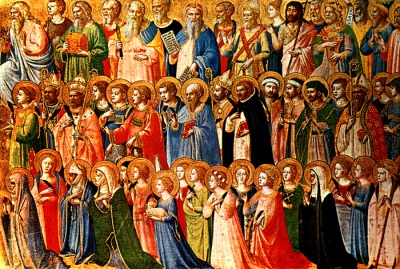
"Who are these wearing white robes, and where did they come from?" If I want to understand and remain faithful to the true meaning of this feast, I have to answer to this question; otherwise, it will be easy to disconnect it from the rest of the Liturgical Calendar and my Adventure of Faith, my life. What we celebrate as a Church is that true Christian life is possible to live! And we have thousands and thousands of witnesses to prove it!
It's easy to misunderstand this solemnity: we tend to look at the Saints in our churches as men and women with the Halo on their heads and we tell stories of their heroic virtues and supernatural deeds. How easy it is to think that is impossible for me to see myself as (potentially) one of them. Forgetting they are "of this world" and they made it: their earthly passions were real, their struggles were real, their victory is real, too.I remember when I heard the story of St Francis making a deal with the wolf of Gubbio. I could not even manage to get my cat respond to my commands, how could I be like Francis and talk to wolves.... I am glad I didn't give up and continue my Journey.
I got to keep this in mind. I cannot look at them only in their final stage but also, and especially, consider them as a whole person. Then, I can even entertain the idea that I am called to the same life. And, by God's grace, I can make it, too.
What does it mean to be "Saint?" I think about the meaning and development of this idea. God was the only one who was called "Saint," that is, "Other," "Separated from..." God was/is so entirely different than us. But by calling His own people, God began to share His "otherness" with them, asking them to be "other", to be a saintly people. He gave them some means (the Law) to demonstrate daily, in their concrete lives and worship, a different way of living. Eventually, they were called to focus on their "interior otherness" as well and a new understanding of Sainthood began to develop: we can only participate in God's sainthood and we cannot become saints on our own. Yet, this participation was still incomplete and for centuries, the God's people yearned for another way.
In Christ, God's Sainthood is shared fully. This idea was so strong in the early Christians that they called each other Saints and called the Church "a communion of Saints." This sainthood was expressed in a particular way in the Eucharist where Saints partecipate to a saintly reality.
Now I get it: to be a saint is to participate in God's life through the means that God Himself has given us through the Church, especially the Sacraments. It is not the fruit of my effort but a gift that comes from the Love that God has for me. Sainthood is my response to His Love.
Now I also understand why Sainthood is associated with the Beatitudes. It's an invitation to live a life of happiness, of blessedness, a life fully realized. It's to live God's own life. I long for this life and I know deep within me that I was made for this.
I can be a saint today; we can be saints today. It is still possible because God continues to make it possible. As matter of fact, now more than ever, the world longs for happiness, for true meaning. Now more than ever the message of the Good News needs to be proclaimed. With such a hunger for happiness, I can see the great potential of a new generation of saints.
I must recommit myself to this life and i must do whatever I can to help people understand that in God they can all find all they long for.
I can almost see new saints marching in....
Monday, October 31, 2011
A different point of view
 Monday of 31st week, A.
 (Romans 11:29-36/Psalm 69:30-31, 33-34, 36/Luke 14:12-14)
This week I have to live my life formed by my encounter with Christ I had yesterday at Mass. The Call is strong: I have to practice what I preach; I cannot say one thing and do another. I am called to honesty as I face the Hidden Deception.
I take my first step today. St Paul helps me. When I look at things from my point of view I realize that when I do something, even something for God, I do it doing my best but then eventually it gets twisted around by my sin. My weakness comes to the fore and I ask God to help me. I know that He takes whatever I have done and turns into a blessing. Knowing this makes my very thankful to Him. So, from my point of view: sin comes first and then God's mercy.
But, thinking about it, I realize that it is not so. In the Garden of Eden, Adam's sin wasn't the first event. The fruit was already there, given to him freely by God. Therefore, God's Grace comes first and than our actions and sin, which leads us to God's Mercy.
The Word has already reminded me about this a couple of days ago. "Everything works together..." that is, everything leads me to Him, not against Him. Events and circumstances are an expression of God's loving will for me, almost like a "sacrament of mercy." All is Grace. The challenge is that I don't always remember this and I don't always act on this concept.
Looking at my sin first may actually work against me. I read in my missal today that "God does not love me because I am good but that I may become good." I like this! It opens me up to God's presence and makes me remain in the freedom that comes from being loved by God.
I got a different point of view: focusing on Grace and Love first generates in me a change in my relationship with God. I want to live this way and if I make this choice today I know I can build and live in a community that reflects God, that imitates Him.
The Gospel brings me deeper into this reality. I cannot see my neighbor as someone from whom I can profit (not only economically but most especially psychologically). Once I see the person who is in front of me as a gift of God to me, I relate to him or her freely without calculations. I know this deep in my heart: I don't like to feel "used" by people so I cannot use them either. Everybody is a gift of God to me: I know, sometimes I want to "return one of the gifts back to the store and settle for a gift card" :) but I have to resist the temptation to dismiss my neighbor as unimportant or as an intrusion. Welcoming everybody as a gift will allow me to live as though it's always Christmas!
What to do then? Doing the Will of God in every present moment allows me to remain focused on God's wisdom which illumines me to see God-in-the-other. By welcoming and loving the other freely and without calculations I can realize that I can build the Civilization of Love. By loving my neighbor freely, I can find Him living with me.
Subscribe to:
Posts (Atom)